Achieving functional safety compliance requires meticulous documentation across the entire system lifecycle. In safety-critical sectors such as automotive, aerospace, medical devices, rail, and chemical processing, documentation is not a administrative afterthought ; it is the definitive, audit-ready engineering record that proves a system can safely handle systematic and random failures.
Under master standards like IEC 61508, ISO 26262, and ISO 13849, an undocumented safety function legally does not exist. Proper documentation establishes a clear history of decisions, tracks hazard mitigations, supports configuration change management, and builds the baseline for third-party compliance assessments.
Phase 1: The Safety Management Foundation (IEC 61508-1 Clause 6)
Before launching into system analysis or circuit design, engineers must document the organizational and procedural frameworks that will govern the project lifecycle. This structural baseline ensures accountability and traceability from day one.
Defining Technical Roles and Accountabilities:
The project documentation must explicitly outline which positions own specific lifecycle activities—including initial hazard analysis, architectural design, software coding, verification testing, and final safety validation. A qualified Functional Safety Manager (FSM) must be formally appointed to oversee the entire compliance program. Furthermore, the documentation must define independent reviewers or assessors who possess sufficient organizational separation from the active development teams to ensure unbiased safety case audits.
Enforcing Strict Document Control:
Safety-related documents must be managed under version-controlled environments with clear naming conventions, revision numbering tracking, and multi-stage approval workflows. Every modification to a safety-critical record must generate an automated audit trail documenting who authorized the change, when it occurred, and the technical rationale behind it.
Personnel Competency Records:
Standards require organizations to track and maintain evidence of engineering competency. This means documenting the specific training, certifications, and prior field experience of every team member assigned to safety-critical tasks to prove they are qualified for their respective roles.
Phase 2: Documenting the System Definition and Boundaries
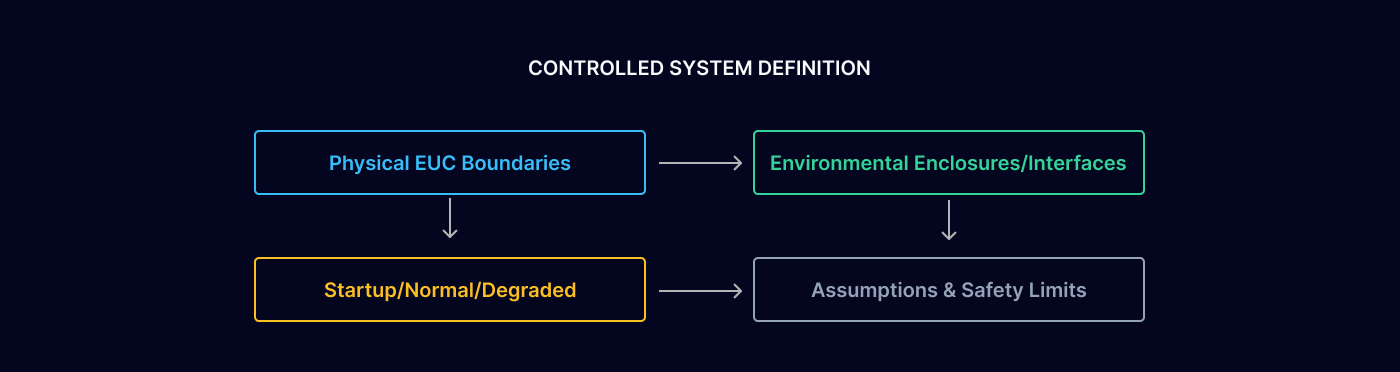
An engineering team cannot accurately analyze risks without a strictly defined and controlled system scope document. The system definition file must clearly establish the operational baseline for the Equipment Under Control (EUC):
Physical and Logical Boundaries:
Explicit documentation of what hardware, software modules, and external communication links are included within the system envelope, and what elements are excluded.
Environmental Interfaces:
Documenting structural interactions with external factors, including power supply tolerances, electromagnetic profiles, ambient temperature ranges, and operator physical access points.
Operational Control Profiles: Defining all distinct operating states of the machinery, including initial startup sequences, normal operation, degraded operational modes, emergency shutdowns, and maintenance override configurations.
Phase 3: The Functional Safety Analysis Stack
As a system transitions from concept to detailed design, the documentation must capture the core safety analysis loop. This technical record directly informs the development of safety requirements and architectural protective layers.
1. Hazard and Risk Analysis (HARA)
The HARA document is the first active engineering record in the lifecycle. It catalogs every potential systemic hazard, calculates the associated initial risk level (using parameters like severity, exposure frequency, and controllability), and establishes high-level safety goals to eliminate or mitigate those risks.
2. Safety Requirements Specification (SRS)
Derived directly from the HARA and specialized safety analyses like Fault Tree Analysis (FTA) or Failure Modes and Effects Analysis (FMEA), the SRS is a comprehensive document that defines exactly what the system must do to maintain safety. Every individual requirement inside the SRS must be atomic, testable, and written as an explicit "shall" statement. The SRS must document:
The required Safety Integrity Level (SIL 1 to SIL 4) or Performance Level (PL a to PL e) for each function.
The exact timing constraints, including maximum safe state transition response times.
Explicit definitions of what constitutes a "safe state" for each unique operational mode.
Diagnostic coverage parameters and specific fault detection and recovery protocols.

Phase 4: Verification, Validation, and Traceability
To satisfy third-party auditors, a safety case must demonstrate unbroken, bidirectional traceability across the entire engineering lifecycle. This means an auditor must be able to select any high-level safety goal from the HARA, trace it down through the technical design requirements in the SRS, locate the exact lines of code or hardware components that implement it, and pull the specific verification test cases that prove it works.
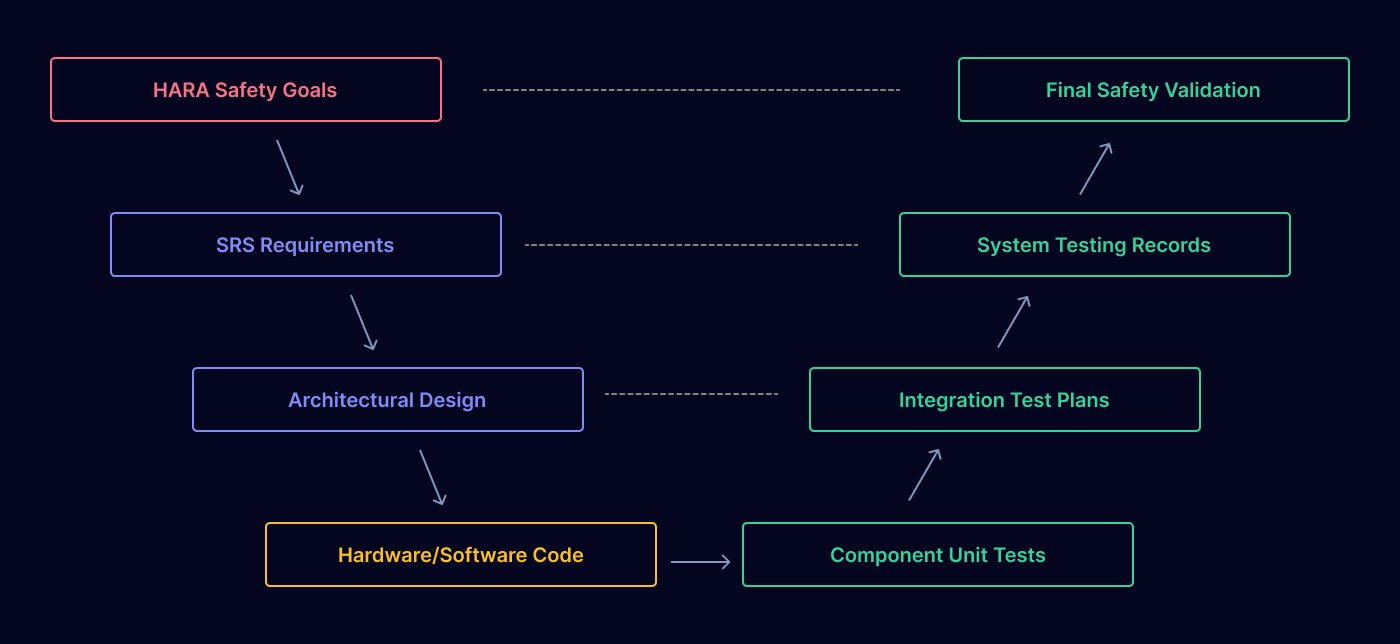
The V&V documentation suite must structurally contain:
Test Plans and Specifications:
Clear documentation outlining test configurations, stimulus inputs, and exact acceptable pass/fail criteria.
Test Execution Records:
Raw output logs, physical measurements, and signed test results validating that the safety functions performed within specification limits under both normal and simulated fault injection environments.
Failure and Deviation Logs:
A precise record of any test failures, unexpected system anomalies, impact analyses of design modifications, and the corrective actions implemented to resolve the discrepancy.
Enterprise Tooling Selection Based on System Complexity
The selection of engineering documentation platforms must scale with the physical and architectural complexity of the project. Attempting to manage highly complex, multi-layered systems using legacy tools introduces severe compliance risks.
Low Complexity Systems:
For smaller equipment with limited inputs, outputs, and safety functions, teams can maintain compliance using organized word processor files, spreadsheets, and basic internal wikis (such as Confluence or Notion) to track HARA matrix data, SRS specifications, and manual change logs.
Medium to High Complexity Systems:
Complex systems with distributed software, networked control links, or high SIL/PL targets require dedicated Requirements Management databases like IBM Rational DOORS, Jama Connect, or Siemens Polarion. These platforms automatically maintain bidirectional traceability matrices, run automated impact analyses during engineering changes, and preserve an unalterable audit ledger to ensure continuous compliance and seamless third-party certification.
Specialized Verification & Safety Case Tools:
Advanced safety lifecycle programs integrate dedicated safety platforms (such as Ansys Medini Analyze or Isograph) to link quantitative reliability predictions directly to underlying FMEA/FTA loops, tracking validation testing records dynamically through automated test platforms (like TestRail or Jira Xray).