An elegantly architected active safety system is only as defensible as the testing framework used to verify it. In high-integrity engineering, comprehensive testing serves as the ultimate technical mechanism to validate that safety functions execute reliably during live operational failures, internal faults are diagnosed and controlled within deterministic timing limits, and mandatory international safety compliance goals are completely fulfilled.
Executing a rigorous testing strategy across the entire system development lifecycle allows engineering teams to identify systematic integration defects early, prevent dangerous undetected failures, and protect human life, property, and corporate reputations from operational liability.
Essential Verification and Validation Testing Methodologies
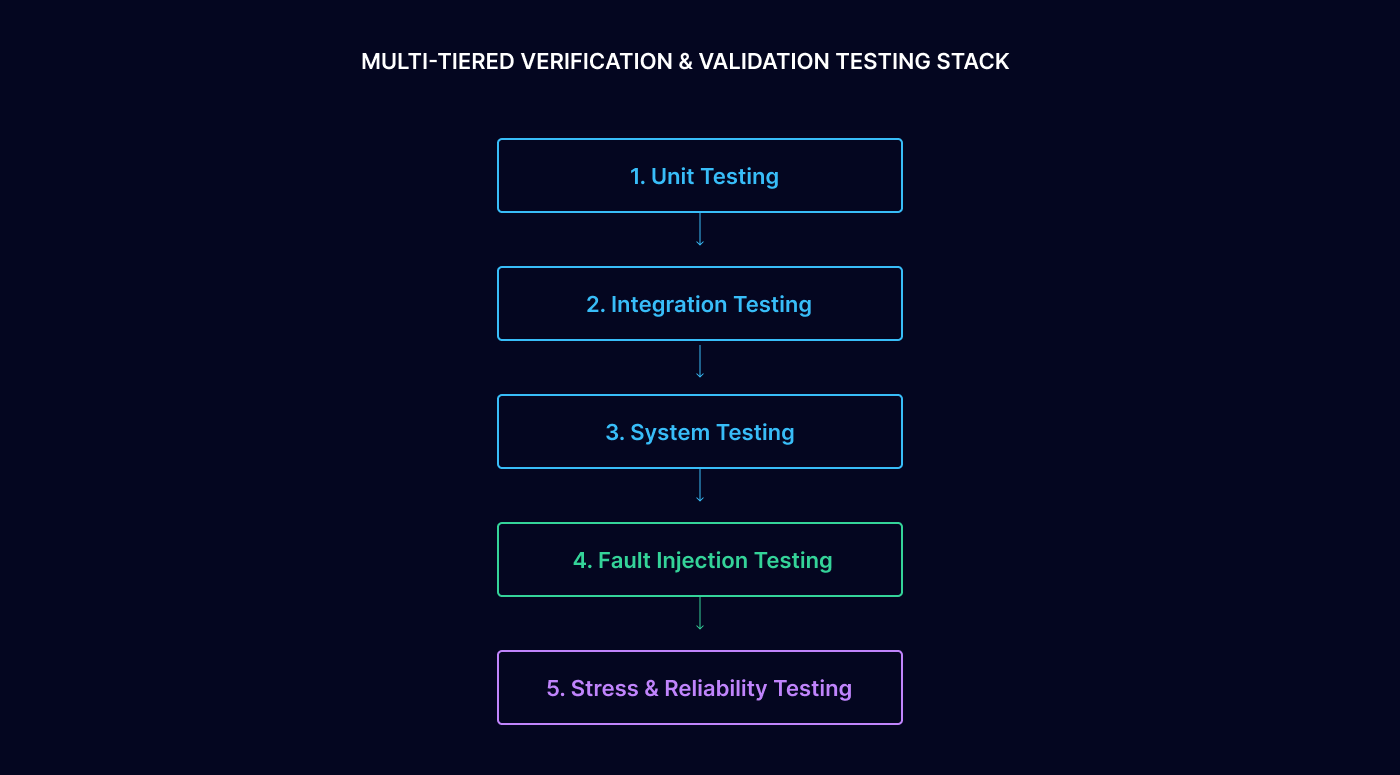
Validating a safety-critical system requires a multi-tiered testing stack, progressing from isolated code and component checkouts up to full-scale stress testing and physical fault injection.
Unit Testing
Unit verification focuses on isolating and evaluating individual software modules, functional subroutines, or specific hardware components. This low-level boundary testing ensures that the specific element functions exactly as dictated by its specification sheet before it interfaces with adjacent components. It is a critical layer for satisfying code-coverage metrics (such as statement, branch, or MC/DC coverage) mandated by standards like ISO 26262 and IEC 61508.
Integration Testing
Integration testing evaluates the communication channels, electrical interfaces, and data exchanges between multiple combined subsystems. This phase is crucial for functional safety because it confirms that critical safety functions remain fully operational when disparate software applications, microcontrollers, and sensory networks interact dynamically under real-time operating conditions.
System Testing
System-level verification evaluates the fully assembled, unified asset as a single entity. The focus shifts to proving that the combined hardware, embedded software, and human-machine interfaces work together to satisfy every high-level requirement detailed in the Safety Requirements Specification (SRS) under both typical operating states and unexpected fault conditions.
Fault Injection Testing
Fault injection is the cornerstone of functional safety verification. It involves deliberately introducing physical or logical anomalies, such as shorting electrical traces to ground, corrupting data packets over a communication bus, breaking sensor wires, or forcing memory stack overflows to actively test the system's internal diagnostic coverage and fail-safe reaction loops. This method provides empirical proof that the architecture will successfully detect a failure and command a controlled transition to a defined safe state.
Stress and Reliability Testing
This method subjects the physical system to extreme environmental and operational boundaries, including thermal extremes, voltage fluctuations, mechanical vibration profiles, and peak data-throughput loads. Reliability testing evaluates whether the safety loop can consistently perform its protective duties over extended lifecycles without experiencing performance degradation or premature component fatigue.
Failure Modes and Effects Analysis (FMEA) Integration
While FMEA is an analytical risk-assessment tool, it acts as a primary driver for testing optimization. By mapping out potential component failure modes, their root causes, and their end-to-end system effects, engineers can prioritize validation testing schedules, ensuring that development hours are concentrated on verifying the most safety-critical failure pathways.
Engineering Toolchain and Testing Infrastructure
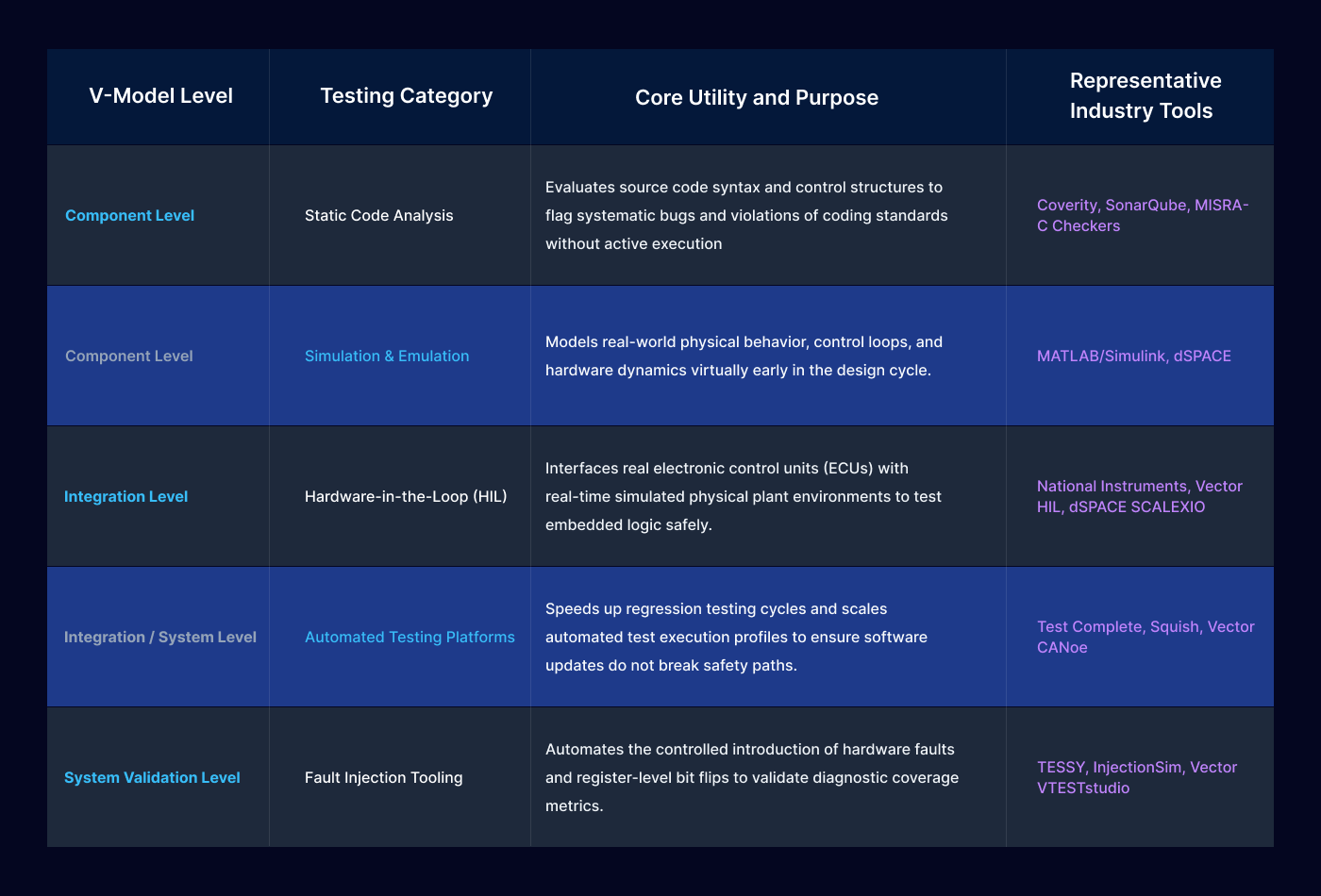
Navigating high-integrity compliance tracks requires selecting a specialized enterprise testing toolchain. Utilizing automated tools bridges the gap between theoretical safe design and field-proven validation metrics.
Strategic Best Practices for Robust Safety Verification
Implement Early and Continuous Testing (CI/CD):
Testing must never be treated as a final gateway at the end of development. Integrating automated static code analysis, software unit verification, and functional regression testing directly into continuous integration and continuous deployment (CI/CD) pipelines allows teams to catch and resolve systematic design flaws before they propagate into physical prototype designs.
Execute Full Worst-Case Boundary Coverage:
Safety systems are built to manage anomalies, meaning testing profiles must deliberately explore edge cases and worst-case operational envelopes. Validation plans must actively stress the architecture under concurrent fault scenarios, maximum environmental limits, and high-stress operational configurations to ensure fail-safe integrity remains absolute.
Foster Multi-Disciplinary Cross-Team Collaboration:
Achieving rock-solid system safety requires continuous technical alignment between safety managers, core hardware designers, embedded software developers, and independent test engineers. Bridging these engineering silos ensures that risk assumptions defined during early hazard analyses (HARA) map directly to real-world validation test cases.
Maintain Continuous Lifecycle Adaptation:
As product lines undergo field updates, software patches, or architectural modifications, the verification testing framework must evolve in lockstep. Organizations must perform comprehensive impact analyses following any system adjustment, update corresponding regression test plans, and re-validate critical safety loops to maintain continuous compliance with international regulations.
Core Engineering Takeaway
Functional safety testing goes far beyond a formal regulatory checkpoint; it is the definitive method used to prove that a complex system will behave predictably when its underlying components fail. By deploying a structured validation framework backed by hardware-in-the-loop simulation, targeted fault injection, and end-to-end requirement traceability, engineering teams can eliminate hidden design vulnerabilities, confirm resilient field performance, and build technologies that earn long-term commercial trust.