In safety-critical systems engineering, risk is an objective, quantifiable variable that must be managed through systematic architectural constraints. Relying on unstructured brainstorming or retrospective safety checks introduces unmitigated vulnerabilities into industrial control hardware and software configurations.
A formal Hazard Analysis and Risk Assessment (HARA) serves as the baseline document for the entire safety lifecycle. It provides a repeatable, auditable methodology to identify systemic hazards, evaluate associated operational risks, and define necessary risk-reduction metrics before detailing system architecture. This guide establishes the operational framework for executing a comprehensive HARA, mapping requirements from machinery baselines to functional safety standards.
The Multi-Tiered Risk Assessment Framework
A robust safety ecosystem treats risk management as a layered, top-down architecture rather than a single isolated calculation. The HARA acts as the master pillar, coordinating with specialized assessments to form a complete validation loop across the V-model lifecycle.
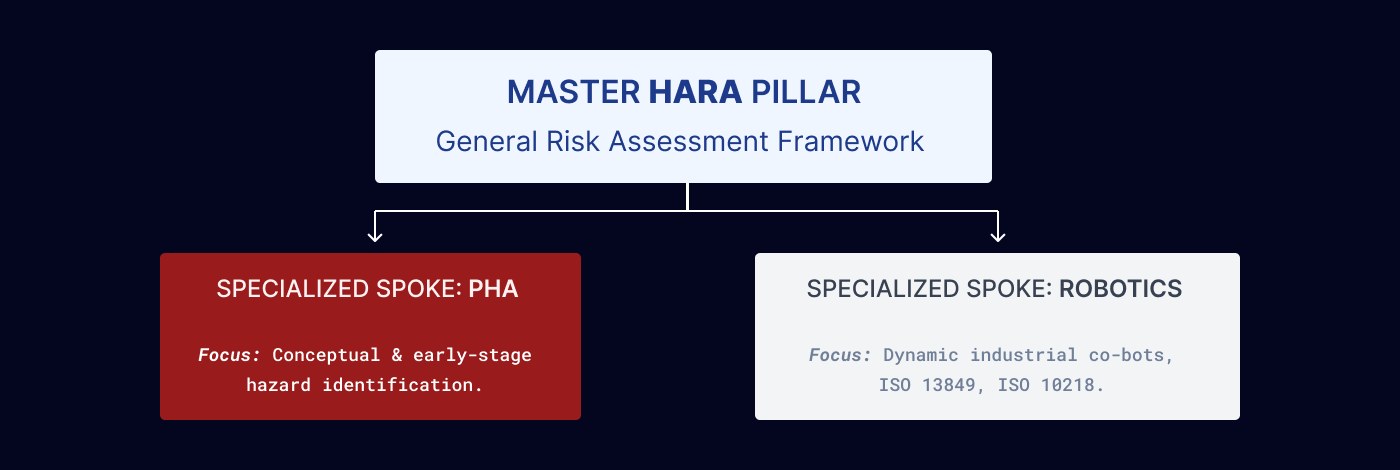
The HARA Master Pillar: Establishes the global risk tolerances, operational scenarios, and environmental boundaries for the equipment under control.
The PHA Spoke: Integrates directly with the HARA during the earliest conceptual phases to map out initial, high-level structural hazards before design freezing occurs.
The Robotics Spoke: Applies the core HARA risk principles to dynamic human-machine collaboration environments, specifically validating complex sensor fields and kinetic boundaries.
Harmonizing Standards: From ISO 12100 to IEC 61508
When executing a HARA for automated systems, engineers must bridge the gap between mechanical machinery safety standards and software-intensive programmable electronic safety standards.

SO 12100: The Machine Foundation
The risk assessment process initiates with ISO 12100, which dictates the global strategy for machinery risk estimation. It focuses on identifying physical hazards and applying the Three-Step Method:
Inherent Design Mitigation: Altering mechanical geometries or physical limits to eliminate the hazard completely.
Safeguarding and Complementary Measures: Introducing physical fencing, light curtains, or pressure mats to isolate personnel from residual hazards.
Information for Use: Utilizing signage, alarms, and operational documentation to alert operators to unmitigated risks.
The Transition to IEC 61508
Where risk reduction relies explicitly on an automated electrical, electronic, or programmable electronic control loop, the assessment transitions from ISO 12100 into the functional safety domain governed by IEC 61508. The HARA bridges these standards by defining whether a risk can be completely resolved mechanically, or if it requires an automated safety function with an assigned target Safety Integrity Level (SIL) to maintain operational stability.
Operational HARA Execution and Risk Parameter Tree
Executing a defensible HARA requires a cross-functional engineering group to evaluate operational hazards across three definitive criteria: Severity (S), Frequency/Exposure (E), and Controllability (C).
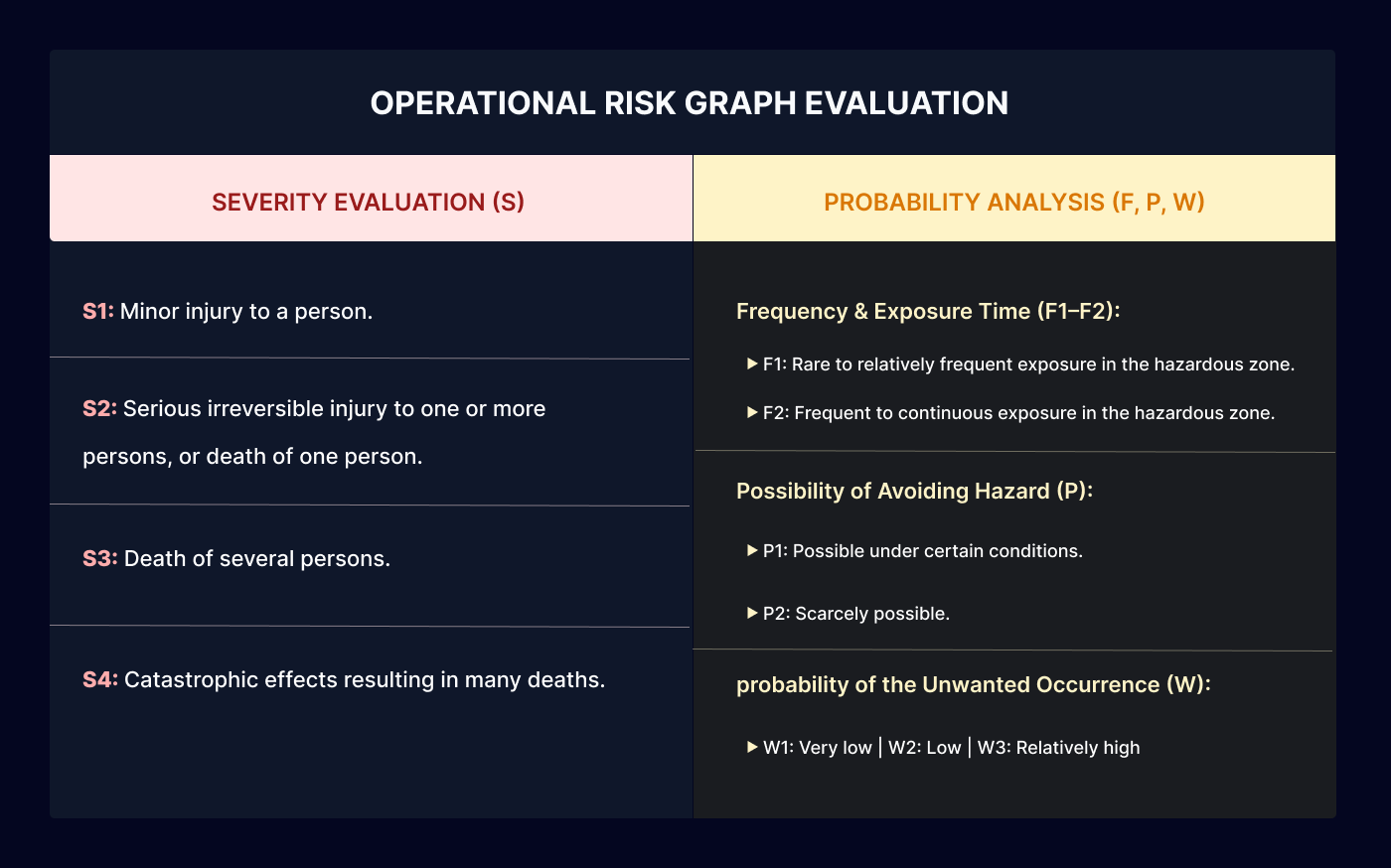
The process moves sequentially through four auditable phases:
Operational Scenario Definition: Define the exact boundaries of the equipment, including its life cycle phases (e.g., normal operation, setup, maintenance), environmental variations, and precise operator interaction windows.
Hazard Identification: Meticulously catalog all potential hazardous events, evaluating how component failures, operator errors, or environmental disturbances interact to create unsafe states.
Risk Estimation and Evaluation: Quantify the baseline risk for each hazard scenario utilizing the parameters detailed in the layout above prior to adding safety controls.
Specification of Risk-Reduction Measures: Define the safety requirements necessary to achieve an acceptable risk profile. If an automated safety system is mandated, specify the required Performance Level (PL) under ISO 13849 or the target SIL under IEC 61508.
Quantitative Integrity Calculations within the HARA
To move a HARA from subjective engineering consensus into an auditable safety case, risk parameters must be linked to deterministic target metrics.
When safety functions operate in a continuous or high-demand profile, the target risk reduction is validated by calculating the Frequency of Dangerous Failures per Hour (PFH). The calculated PFH value must fall within the precise mathematical thresholds defined by the target safety standard:
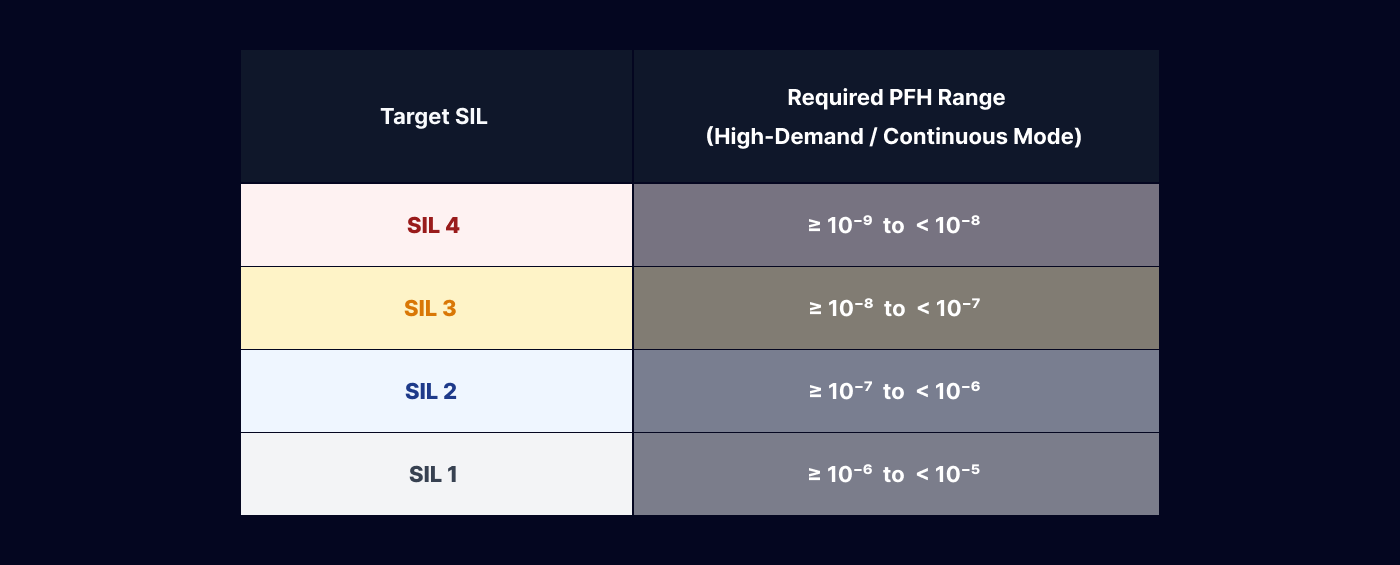
By binding these exact failure frequency envelopes to the HARA early in the V-model validation lifecycle, systems engineers establish clean, non-negotiable performance parameters for all downstream integration and verification testing.
Engineering Management Checklist for HARA Compliance
Cross-Functional Architecture: Verify that the HARA includes input from mechanical, controls, and systems engineering fields to ensure zero gaps in hazard cross-talk.
Bidirectional Linking: Confirm that specialized PHA and robotic safety cases map back directly to the global operational parameters established in this master document.
Target Accountability: Ensure every hazard requiring automated control is mapped to a precise SIL/PL target, complete with designated PFH boundaries before design release.