Advanced robotics, autonomous systems, and industrial machinery manufacturers routinely invest significant engineering capital to ensure their platforms achieve validated safety thresholds. In modern engineering, functional safety is no longer treated as a detached regulatory box-ticking exercise or an administrative speed bump. It is a non-negotiable operational expectation demanded by corporate buyers, end-users, and international regulatory authorities.
Yet, many organizations continue to operate under the outdated and highly risky mindset that safety is an overhead cost center to be addressed late in the product development lifecycle. Attempting to bolt on safety mechanisms after a system's core architecture is locked in compromises design integrity, introduces engineering bottlenecks, and exposes the enterprise to severe operational liability. Functional safety must be integrated from day one as a foundational design feature that builds market trust, reduces operational risk, and strengthens product commercialization.
Safety as a Primary Product Attribute
When purchasing a modern automobile, a consumer is not simply paying for a mechanical engine and a chassis; they are investing in the underlying peace of mind that the brakes will actuate on demand, the airbags will deploy during an impact, and complex electronics will not fail at highway speeds. This standard remains identical across the commercial robotics, medical device, and industrial automation sectors. Modern B2B buyers expect active safety to be built into the system's core architecture from the outset, rather than patched onto a completed design.
This paradigm shift requires engineering teams to reframe safety from an external regulatory hurdle into a primary product attribute fully equivalent to battery lifecycle capacity, mechanical range of motion, or software execution speed. To satisfy this engineering definition, safety functions must be factored into the earliest concept phases, directly influence hardware and software layout choices, and undergo rigorous validation at every stage of development.
The Commercial Consequences of Post-Design Safety Fixes
Treating safety as a late-stage add-on carries severe real-world technical and financial consequences. A definitive example is the tragic 2018 autonomous vehicle testing fatality in Arizona. Subsequent forensic investigations revealed that while the vehicle’s sensor suite and perception system successfully detected the pedestrian, the classification algorithms failed to accurately identify the target as an immediate obstacle in time to command the brakes.
The operational and commercial fallout for the developer was immediate and severe:
Public and stakeholder credibility collapsed rapidly.
Federal regulatory bodies intensified compliance oversight and forced immediate testing shutdowns.
Active development programs were paused indefinitely, resulting in extreme schedule slippage and lasting corporate reputational damage.
This incident serves as a critical warning not only for the autonomous vehicle space, but for any company engineering safety-critical systems including warehouse automated guided vehicles (AGVs), automated surgical instrumentation, and drone delivery platforms. Insufficient safety planning early in the design cycle introduces systemic bugs that can cause devastating operational failures.
B2B Procurement and Market Access Metrics
Investing in documented functional safety processes and formal third-party compliance certification provides a substantial competitive advantage in the global market. In high-integrity industries, safety is no longer a premium differentiator; it is the baseline requirement for market access.
Mandatory Purchasing Standards:
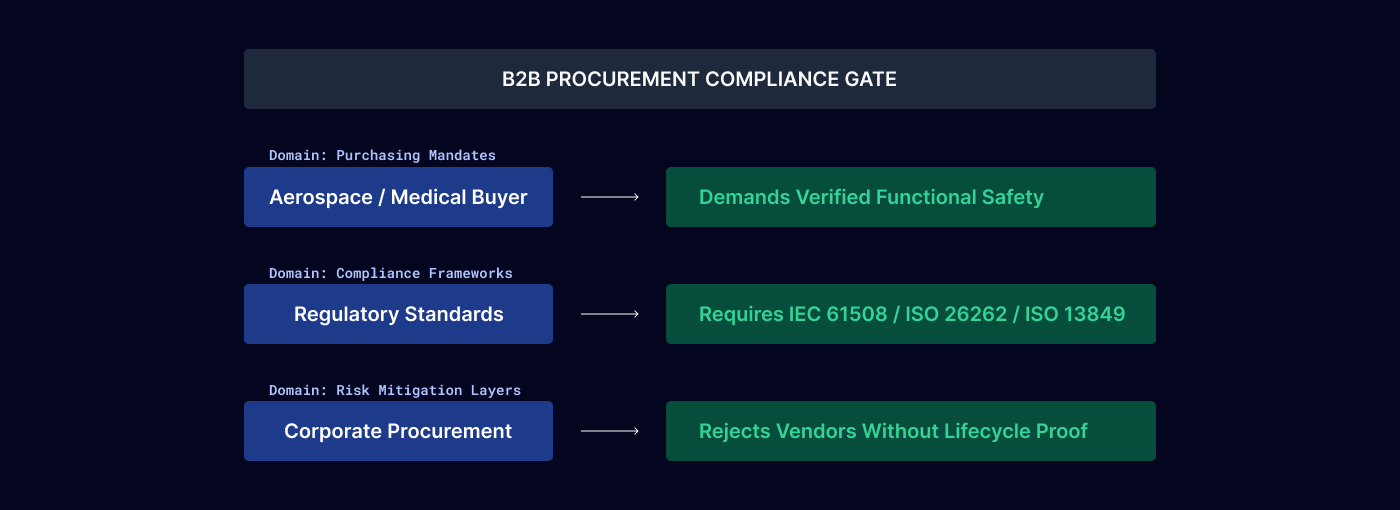
Institutional buyers across the aerospace, medical, and automotive domains demand verified functional safety certifications before clearing a product for procurement consideration.
Regulatory Compliance Frameworks:
Global regulatory bodies continuously tighten legal frameworks, mandating verified compliance with master engineering standards such as IEC 61508 (industrial automation), ISO 26262 (automotive), and ISO 13849 (machinery safety).
Procurement Risk Mitigation:
Enterprise procurement managers are explicitly trained to steer clear of equipment vendors who cannot present objective, traceable evidence of a structured safety lifecycle approach.
Integrating Safety Throughout the Development Lifecycle
Treating safety as a core design feature requires embedding structured engineering tasks across every distinct phase of the system development lifecycle. The safety lifecycle is a systematic loop designed explicitly to eliminate systematic design flaws and mitigate random hardware failures to earn customer trust.

1. Concept Phase
The lifecycle initiates with a formal Hazard and Risk Analysis (HARA). Engineering teams must methodically analyze the system configuration to document what could go wrong under both normal operation and foreseeable misuse states, establishing objective criteria to reduce those risks to acceptable targets.
2. Requirements & Architecture
High-level safety goals are translated into explicit safety functions and distributed down into specific system components. Each allocated function must be assigned a clear reliability target, such as a quantitative Safety Integrity Level (SIL) under IEC 61508 or a Performance Level (PL) under ISO 13849.
3. Design & Implementation
During active development, engineers apply specialized design techniques to guarantee the system remains safe even when an internal component suffers a complete failure. This phase requires implementing fail-safe design principles, hardware component redundancy, automated internal diagnostic routines, and defensive software programming.
4. Verification & Validation (V&V)
The fully integrated platform undergoes rigorous, documented testing loops to confirm the safety mechanisms operate exactly as specified under realistic environmental profiles. V&V engineers execute worst-case stress testing and physical fault injection routines to verify safe-state transitions during active failures.
5. Maintenance & Field Updates
Functional safety compliance remains active post-deployment. Long-term field safety must be sustained through version-controlled technical documentation, structured technician training programs, secure software update deployment protocols, and continuous field-performance telemetry logging.
Engineering Culture and Executive Leadership
Executing a successful functional safety lifecycle is impossible without direct commitment and buy-in from executive leadership. When management treats safety purely as an overhead expense or a schedule penalty, development teams face implicit operational pressure to bypass rigorous testing loops and cut engineering corners to save immediate costs.
Conversely, when corporate leadership reframes functional safety as a non-negotiable metric of engineering excellence, the entire development dynamic shifts. Design engineers are structurally empowered to flag technical anomalies, follow rigorous lifecycle best practices, and prioritize systematic risk reduction even when those activities introduce additional architectural complexity or timeline strains. Nurturing an organizational culture where safety inputs are actively respected and traceably resolved remains the single most powerful driver of real-world safety success.
While establishing functional safety processes adds up-front design complexity, the long-term financial and operational investment yields substantial rewards. Much like data encryption or optimized user experience, safety is a core requirement of sustainable modern product design. Organizations that build safety into their platforms from day one successfully protect human lives, eliminate severe operational liabilities, strengthen their market brand, and secure the long-term commercial trust of their enterprise customers.