When autonomous systems and robotics dominate industry headlines, public conversations often focus on speculative science-fiction scenarios. Inside the engineering trenches, however, the real story centers on rigorous development, intense schedule pressures, and the challenge of navigating complex compliance standards.
A significant gap often exists between an organization’s expectations of the functional safety certification process and the technical realities it actually entails. A fundamental truth must be established upfront: the objective of a functional safety program is not to engineer an absolutely zero-risk product, as achieving 100% absolute safety is a physical impossibility. Rather, the true goal is to systematically understand your system's underlying risks, design appropriate architectural safeguards, and document objective engineering evidence in a manner that a third-party certification body can seamlessly verify.
The Regulatory and Standards Landscape
If your engineering team is developing robotic arms, autonomous mobile robots (AMRs), self-driving vehicles, or complex industrial machinery, you will inevitably operate within the framework of international safety standards. The foundational pillar across these domains is IEC 61508, which introduced the benchmark concept of Safety Integrity Levels (SIL) a quantitative metric evaluating the target reliability required for a specific safety function.
From this master document, an array of specialized, sector-specific standards has evolved to govern distinct commercial ecosystems:
ISO 13849:
Governs safety-related parts of control systems for machinery, utilizing Performance Levels (PL a to PL e) as its core risk metric.
IEC 62061:
Serves as the alternative machinery sector standard, aligning closely with the primary IEC 61508 framework by using SIL designations directly.
ISO 26262:
Dictates strict functional safety development lifecycles and compliance pathways specifically for passenger road vehicles.
ISO 3691-4:
Applies explicitly to driverless industrial trucks, including automated guided vehicles (AGVs) and autonomous mobile robots.
ISO 12100:
Establishes the overarching machinery safety baseline, providing the foundational risk assessment and risk reduction methodology that feeds into electronic control designs.
Where Safety Projects Encounter Critical Trouble
The architectural and operational failure modes of compliance projects are remarkably consistent across different engineering industries. Projects generally derail due to four recurring blind spots:
1. Post-Design Safety Implementation (Late Starts)
The engineering instinct to "get the product working first" and address compliance documentation near the end of the timeline is the most expensive mistake a company can make. Safety requirements must directly shape the physical architecture, hardware selection, and software logic from day one. Attempting to document compliance after the design is locked forces devastating engineering bottlenecks and costly hardware re-spins.
2. The Junior Consultant Trap
Many organizations scale up their safety compliance efforts by onboarding outside consulting agencies, expecting those third-party resources to autonomously own and execute the safety lifecycle. Instead, companies frequently find themselves receiving junior engineers who require continuous technical direction, oversight, and basic training from the client's own over-stretched internal team.
3. Over-Conservative Requirement Inflation
The goal of functional safety standards is to reduce risk to a tolerable level, not to eliminate risk entirely. When external advisors apply standard clauses too conservatively demanding higher safety targets or more complex architectures than the application actually requires they introduce severe schedule drag and massive budget overruns without adding true safety value.
4. The Structural Infrastructure Gap
Hiring individual safety engineers without an existing, organizational safety infrastructure often stalls out. While these engineers may be personally capable, they frequently lack the systemic experience, pre-built template frameworks, and lifecycle blueprints required to build and lead a comprehensive certification program from absolute scratch.
Engineering Safeties: The Core Analytical Tools
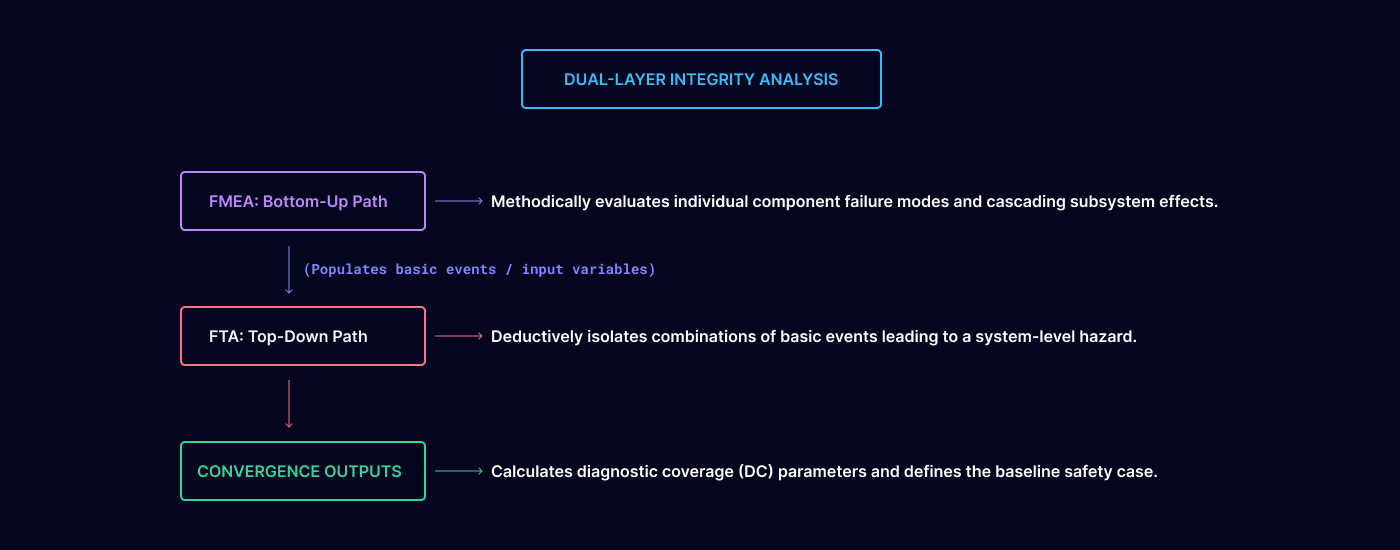
Functional safety must be handled as an explicit product attribute rather than an administrative overhead liability. The fundamental architectural decisions that dictate whether a platform will successfully certify are finalized within the first third of the development process. This phase relies heavily on two primary analytical mechanisms:
Failure Mode and Effects Analysis (FMEA):
A bottom-up analytical discipline that methodically examines every individual component, hardware trace, and software module to identify potential failure modes, calculating their immediate effects on adjacent subsystems.
Fault Tree Analysis (FTA):
A top-down deductive engineering process that starts with a singular, high-level undesired system event (such as uncommented motion) and works backward using Boolean logic gates to isolate the exact combinations of component failures that could trigger the hazard.
Enforcing Strict Bidirectional Traceability
The technical differentiator between documentation that successfully supports a third-party audit and documentation that merely fills a folder is bidirectional traceability. A defensible safety case requires a completely unbroken data loop across the system lifecycle.
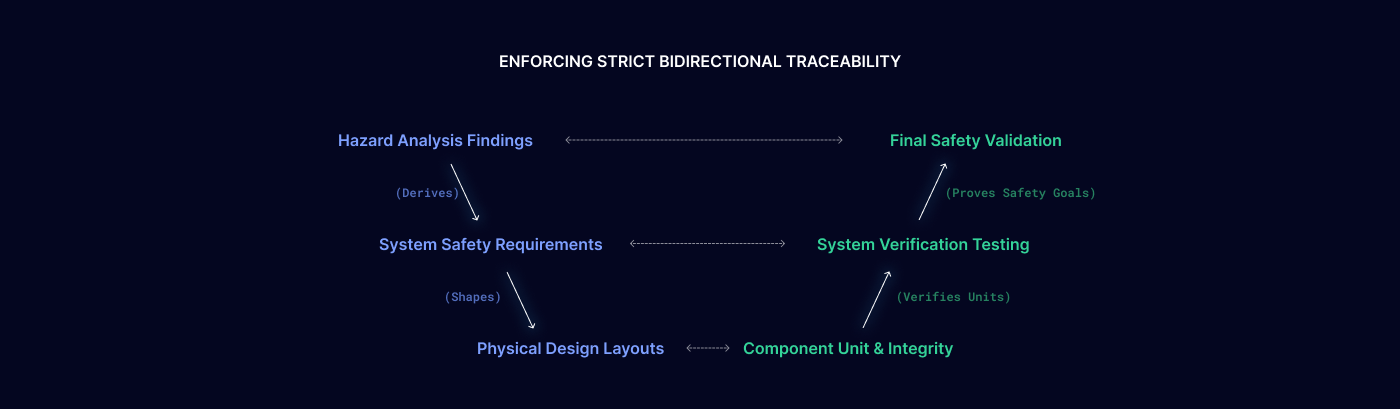
Every single safety requirement inside your specification file must map directly back to a specific hazard identified during the initial risk analysis. Concurrently, every physical design decision, software function, and component selection affecting that safety loop must trace forward to an active requirement. Finally, the verification test plans and validation test logs must explicitly link to the exact requirements they are tasked with proving. Maintaining this disciplined data mapping ensures that no configuration gaps exist when external assessors audit the system.
Navigating the Assessment Interface
Successfully clearing a third-party assessment depends heavily on understanding the technical expectations of compliance auditors. Certification bodies do not operate on subjective interpretations; they demand structured, unambiguous objective evidence. Presenting an audit-ready technical file that clearly details your safety lifecycle, shows complete requirement traceability, and provides verified fault-injection test logs accelerates the review process, cuts down on assessment cycles, and secures a predictable path to market approval.