For safety-critical systems, late-stage design modifications driven by overlooked compliance requirements carry severe financial and operational penalties. Remediation becomes exponentially more complex once hardware architectures are finalized and component procurement is complete. Executing a Preliminary Hazard Analysis (PHA) addresses this vulnerability by establishing rigorous safety constraints before the detailed design phase begins.
As an initial risk assessment framework, the PHA identifies potential hazards, evaluates associated operational risks, and defines essential safety characteristics during the earliest conceptual stages of a project.
Lifecycle Positioning within the V-Model
A common systemic error in complex systems engineering is treating safety analysis as a parallel activity to detailing or prototyping. In a compliant development workflow, a PHA is executed at the absolute genesis of the project lifecycle.
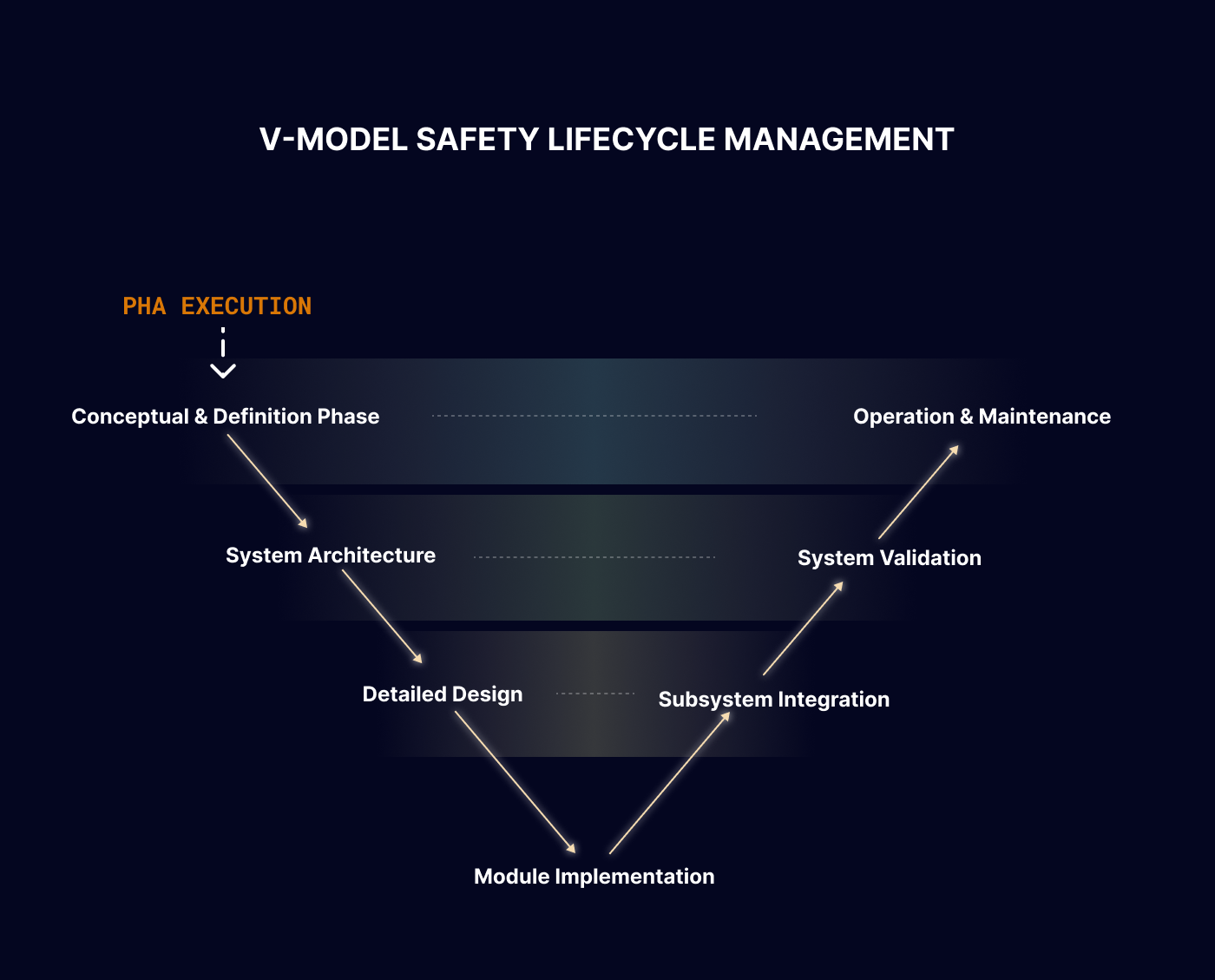
The PHA takes place exclusively during the concept and definition phase, prior to the development of the system architecture. At this point, the system is defined by its intended functions, environmental boundaries, and high-level Concepts of Operation (ConOps) rather than specific hardware components.
Deriving safety requirements at this early stage allows controls engineers to establish physical layout constraints, integrate inherent redundancies, and define fail-safe states before architectural locking occurs. This timing directly mitigates the risk of late-stage redesigns during final certification phases.
Structural Execution and Hazard Propagation
Conducting a rigorous PHA requires an independent, cross-functional engineering team to methodically map out failure vectors. Hazards do not occur in isolation; they follow a traceable path from an initial root cause to an environmental consequence.
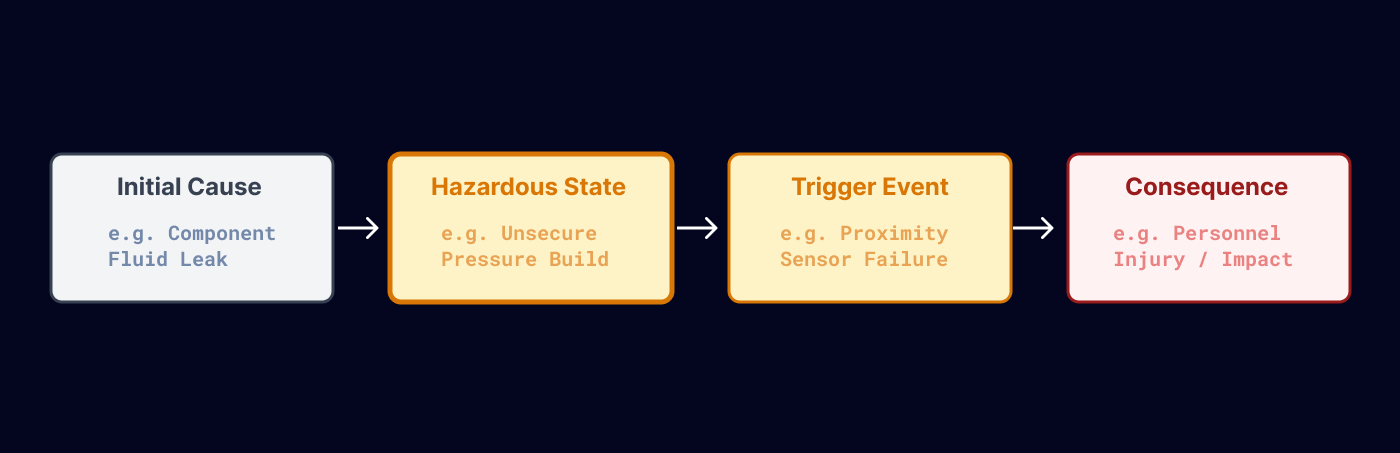
The execution process must progress through four key operational stages:
System Boundary and Environmental Definition: Establish the operating envelope, physical limits, and environmental variables (e.g., thermal ranges, explosive atmospheres, or human-machine interaction spaces).
Hazard Identification: Utilizing historical failure data, legacy engineering records, and safety standards (such as IEC 61508 or ISO 12100), define all potential energy releases, mechanical trapping zones, command failures, or environmental stressors.
Qualitative and Quantitative Risk Estimation: Evaluate the worst-case operational consequences of each hazard. Risk is determined by combining Severity (S) the maximum potential harm to personnel, equipment, or environment and Probability/Frequency (F) of exposure and occurrence.
Development of Safety Controls: Apply the safety engineering hierarchy of controls. Focus first on eliminating the hazard through inherent design choices. Where elimination is impossible, specify automated safety functions or hardware mitigation barriers to reduce residual risk to acceptable targets.
Downstream Traceability: The Blueprint for SHA and HARA
The artifacts generated during a PHA serve as the direct foundational data for all subsequent, highly detailed safety analyses across the engineering lifecycle.
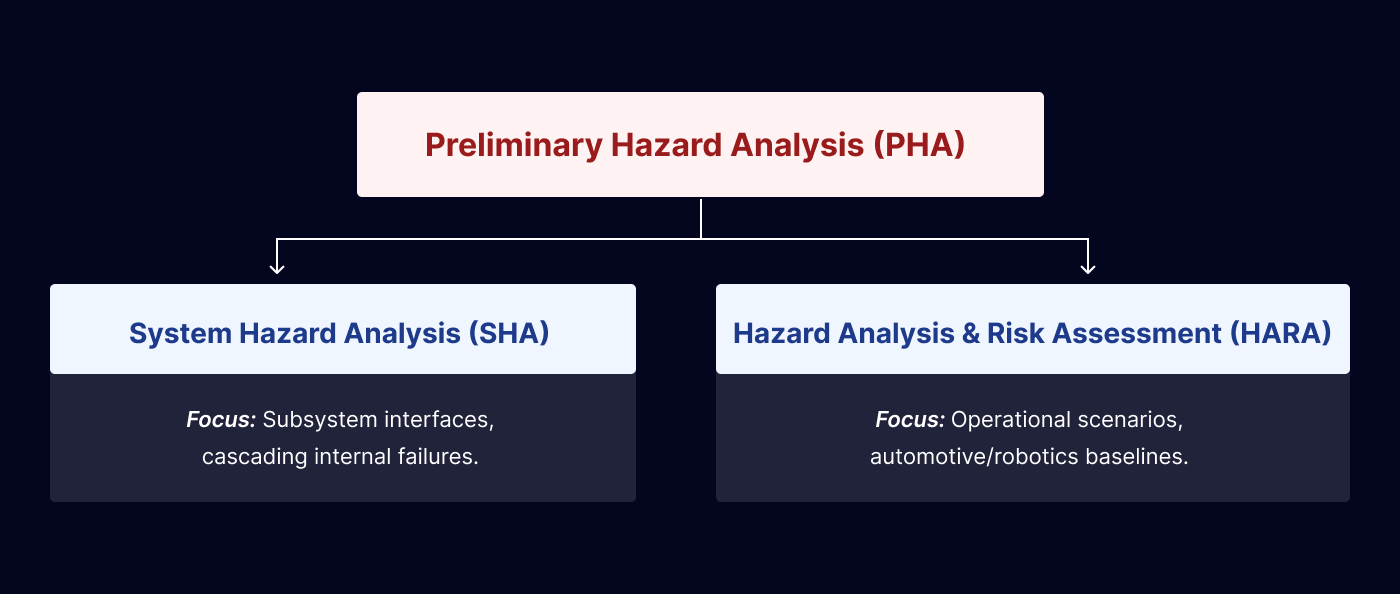
Transition to System Hazard Analysis (SHA)
While the PHA operates at the conceptual level, the System Hazard Analysis (SHA) focuses on the detailed design architecture. The SHA uses the high-level hazards identified in the PHA as a structural baseline, analyzing how component-level failures, software interface errors, and subsystem interactions might propagate to trigger those original system-level hazards.
Transition to Hazard Analysis and Risk Assessment (HARA)
In industry verticals governed by application-specific standards like ISO 26262 (automotive) or ISO 3691-4 (autonomous mobile robots), the PHA outputs map directly into a formal HARA. The HARA contextualizes the early hazards by combining them with precise operational situations (e.g., assessing an autonomous transit vehicle experiencing a total loss of braking torque on a high-speed grade versus a low-speed staging yard).
Without an audited PHA baseline, downstream assessments like SHAs and HARAs frequently suffer from critical gaps regarding common-cause failure modes.
Quantitative Safety Integrity: SIL, PFD_avg, and PFH
A PHA moves out of qualitative speculation when safety requirements are mapped directly to quantitative verification metrics.
When an early hazard analysis indicates that a risk must be mitigated via an automated safety function, that function must be assigned a target Safety Integrity Level (SIL) or Performance Level (PL). Higher unmitigated risk demands a more stringent safety target (ranging from SIL 1 to SIL 4), which exponentially escalates software assurance and hardware verification protocols. Utilizing the PHA to eliminate hazards via mechanical design minimizes the required SIL targets of the remaining control loops, reducing overall validation scope.
For safety functions operating in a low-demand mode (where the frequency of demands is no greater than one per year), the quantitative target is defined by the Average Probability of Failure on Demand (PFD_avg). For a standard single-channel safety loop, this value is mathematically approximated as:
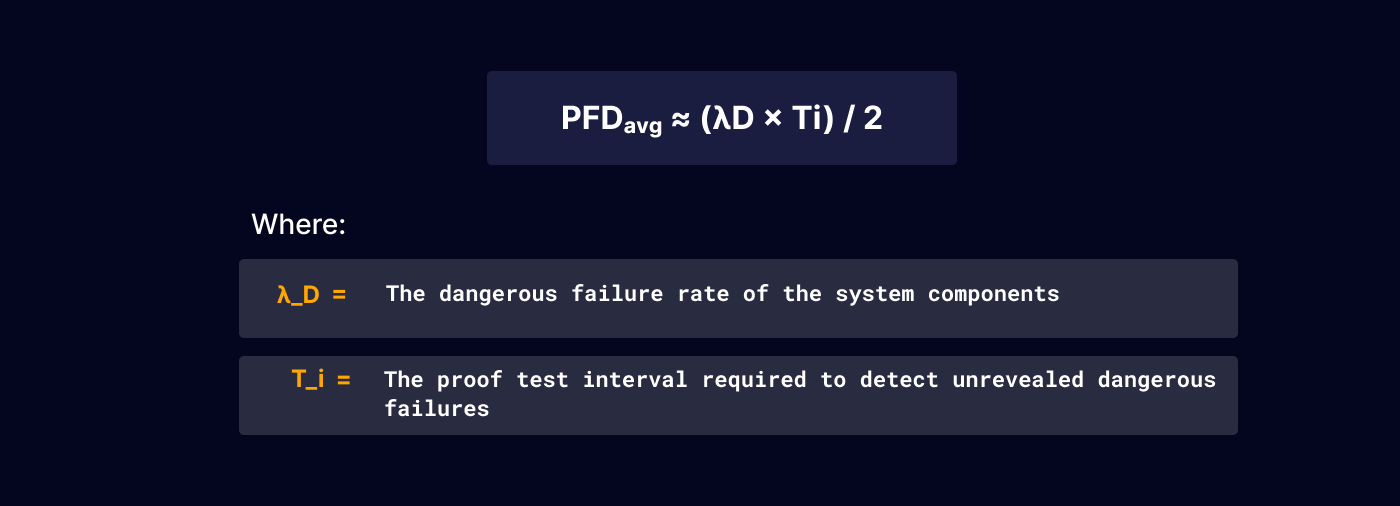
For safety functions operating in high-demand or continuous mode (such as autonomous robotics guidance loops or rail signaling infrastructure), compliance shifts to calculating the Frequency of Dangerous Failures per Hour (PFH).
Establishing these deterministic boundaries during the PHA phase provides engineering teams with precise mathematical parameters early in the development lifecycle. This ensures component selection, interface controls, and reliability modeling are fully aligned with final compliance targets from day one.
Engineering Management Checklist
Milestone Locking: Verify the PHA is fully completed, reviewed, and signed off before authorizing system-level architectural design.
Bidirectional Traceability: Map every conceptual hazard directly to a distinct safety requirement within the tracking matrix to guarantee verification at the V-model validation stage.
Reliability Allocation: Ensure that all automated safety functions identified in the PHA are assigned explicit target SIL, PFD_avg, or PFH boundaries to guide component procurement.